Ejectors
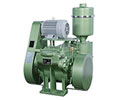
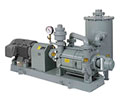
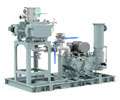
An ejector is a vacuum pump driven by steam or similar media with no mechanical moving parts.
Its simple construction enables virtually trouble-free operation. It’s easy to operate and can be scaled up easily. Ejectors are used in many applications, including degassing for molten steel and polymerization for synthetic fiber.
A single-stage ejector can compress up to atmospheric pressure, while multistage ejectors can produce high vacuum. They can work with other types of vacuum pumps as part of a vacuum pump system.
Osaka Vacuum can manufacture ejector systems that use various motive sources for a wide range of applications.
The most popular type is the steam ejector, which uses water vapor as the motive fluid. Air and water can also serve as motive fluids, depending on the application. The pumps can be made from various materials, including corrosion-resistant materials such as titanium or carbide.
Osaka Vacuum can produce ejector systems that meet customers’ needs based on our proven technology and track record.
Industrial fields
- Metal and Steel
- Chemical
- Energy
- Material
- Medical / Pharmaceuticals
- Foods
- Heavy electrical equipment
- Transport
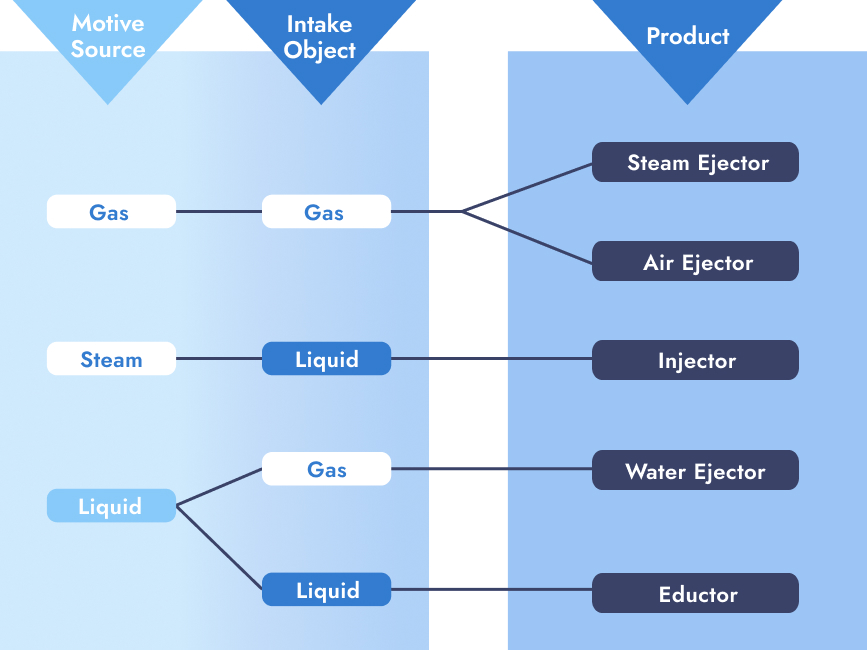
Types of Ejectors
Steam Ejector
A steam ejector is driven by steam and pumps gas. It is simple in construction, rarely fails, and is easy to operate. Multistage ejectors can achieve a high vacuum.
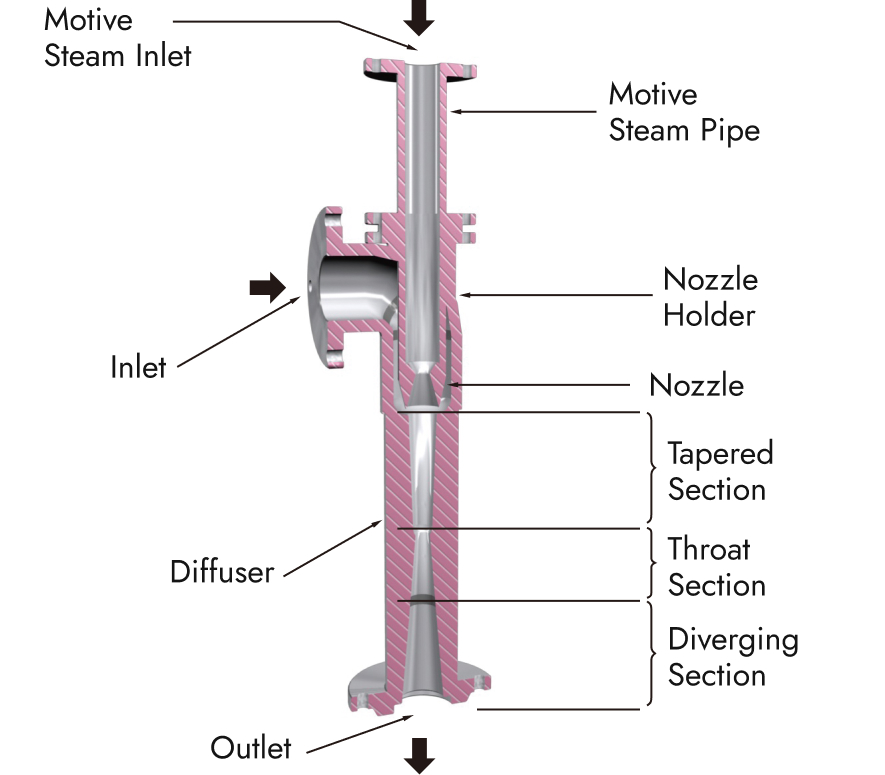
Steam Ejector Cross-section
Features
Ideal for pumping high-temperature gases containing dust, as it has no moving parts or lubricating oil.
It can be made entirely of corrosion-resistant material. It can be easily scaled up for a large pumping speed.
It’s less expensive to manufacture than a mechanical vacuum pump of the same pumping speed.
A surface condenser can prevent process gas from contaminating cooling water.
It is reliable with no moving parts. It is easy to operate.
Materials
| Main Components | Standard | Corrosion Resistance Required |
|---|---|---|
| Suction Chamber and Diffuser | Standard Cast SteelCarbon Steel |
Corrosion Resistance Required Stainless Cast Steel, Stainless Steel, Titanium, Hastelloy, Monel, Carbon (Outer Cylinder Carbon Steel) |
| Nozzle and Nozzle Holder | Standard Stainless Steel |
Corrosion Resistance Required Titanium, Hastelloy, Monel, Carbon |
| Motive Steam Pipe | Standard Carbon Steel |
Corrosion Resistance Required Stainless Steel, Titanium, Hastelloy, Monel |
Operating Principle
A steam ejector is composed of a steam nozzle, a suction chamber, a diffuser, and other components.
First, the motive steam (which is usually supplied as dry saturated steam or slightly superheated steam at 0.25 to 1.6 MPaG) reduces its pressure from the supply pressure down to the pressure within the suction chamber as it passes through the nozzle (adiabatic expansion). This pressure decrease is converted into momentum. As it passes through the diverging section of the nozzle, it is further accelerated to become a supersonic flow, which is then injected into the suction chamber and the diffuser.
Next, the suction gas is accelerated by the negative pressure gradient formed in the converging section of the diffuser due to the motive steam and by mixing with the motive steam itself. Then, the motive steam is decelerated to subsonic speed via a shock wave in the diffuser throat, causing a sharp pressure increase. Furthermore, the steam experiences a slight deceleration and simultaneous pressure recovery in the diverging section before exiting the diffuser.
The above description applies to the case where the backing pressure (the pressure at the diffuser outlet) does not exceed a certain value known as the maximum discharge pressure (or critical back pressure). In this case, the motive steam and the suction gas both momentarily become supersonic within the diffuser, thus preventing any fluctuation or change at the diffuser outlet from being transmitted to the inlet side. Therefore, the suction characteristic is not affected by the backing pressure.
On the other hand, when the backing pressure exceeds the maximum discharge pressure, the suction gas passes through the diffuser with portions remaining subsonic. As a result, the suction characteristic becomes dependent on the backing pressure and can cause pulsations in the suction pressure. These phenomena are considered significant characteristics of ejectors.